
Jefferson Projected Versus Completed Release
A projected date estimates a future point under the record owner's present calculation. A completed release event records what actually happened. IDOC labels three fields separately: Projected Parole Date, Last Paroled Date, and Projected Discharge Date. The first is prospective. The second is historical and can relate to an earlier episode. The third usually points to the expected end of the sentence and supervision structure.
Physical prison release to mandatory supervised release, or MSR, does not equal final discharge. A person can live in the community while IDOC Parole supervises the rest of the sentence under Prisoner Review Board conditions. A transfer to another prison, county, USMS, or another custodian is not community release at all.
A pretrial detainee has no sentence-based projected date. The signed court order controls legal authority, while the Jefferson County Justice Center record confirms physical processing.
Find Jefferson Projected Release Dates
Start with the agency that owns the sentence. The Justice Center, Big Muddy River Correctional Center, and a federal custodian use separate systems. A person disappearing from the Sheriff app may have entered IDOC custody rather than gone home.
- Identify the last custodian and court case. Use the booking number, case number, or IDOC number when known.
- For a state prisoner, search the IDOC current and former offender form.
- Confirm Offender Status, Location, and sentencing county before reading the admission and release block.
- Copy Projected Parole Date, Last Paroled Date, and Projected Discharge Date exactly. Keep projections apart from completed events.
- For a county sentence, read the sentencing order and ask the Sheriff to confirm credited days, release authority, and actual discharge.
- After the expected event, recheck the owner and request written proof if needed.
The Jefferson County release-record search provides the full path when the last custodian is uncertain.
Illinois IDOC Sentence Credit Rules
730 ILCS 5/3-6-3 governs IDOC sentence credit, including awards, revocation, and offense-specific limits. The statute contains several regimes tied to the offense and offense date. It cannot be reduced to one percentage for every Illinois prisoner.
For listed serious offenses, credit may be limited to 4.5 days per month, which produces the familiar 85 percent minimum. Other listed cases have 75 percent or 100 percent floors. Other sentences follow different credit rules, and a natural-life sentence does not become a projected release through ordinary sentence credit. Saying all Illinois inmates serve 85 percent would be false.
Earned Sentence Credit is not a promised amount. Eligibility, programming, conduct, exclusions, IDOC discretion, and later revocation matter. IDOC says it cannot predict a future award because key master-record material is confidential. A public calculator would create false precision, so no Jefferson inmate date should be computed with a homemade formula.
Why Jefferson Release Dates Change
IDOC recalculates from the sentence structure and valid record inputs. Even a date that has passed can coexist with current custody after a correction, return, detainer, or new episode. Read the current status before drawing a conclusion.
| Factor | Possible effect | Record owner |
|---|---|---|
| Offense date and class | Selects the controlling credit regime | Court and IDOC |
| Presentence custody credit | Credits eligible time already held | Court order and IDOC |
| Concurrent or consecutive terms | Terms overlap or run one after another | Court and IDOC |
| Credit award or revocation | Moves the current projection within legal limits | IDOC |
| Amended mittimus | Corrects the commitment order and can force recalculation | Court and IDOC |
| Detainer or receiving agency | May cause transfer instead of community release | Holding and receiving agencies |
| MSR or release plan | Can affect the transition and supervision stage | IDOC and PRB |
A mittimus is the court's commitment order. A detainer asks the current custodian to hold or notify another agency. Neither should be inferred from a delayed date; read the actual record.
Confirm Jefferson Completed Release
For IDOC, begin with Offender Status and Location. Work release remains custody. Then compare the future fields with any completed release information and each sentence row. “Sentence Discharged?: YES” applies to that row only. Another sentence can remain active or run consecutively. IDOC number and birth date are stronger identity checks than a photo.
If a formal answer matters, use the IDOC FOIA route for a named IDOC number and request final release date, release type, status, admission or discharge dates, and sentencing information. IDOC posts a standard response period and written extension path under Illinois FOIA, but exempt master-file details can be withheld.
The Jefferson County VINELink release check can provide a pending event alert. It is not certified proof. Compare its wording and time with the record owner.
Jefferson County Jail Credit
County jail sentences use a different source. The County Jail Good Behavior Allowance Act, 730 ILCS 130/3, concerns county-jail good behavior. Do not import IDOC's 4.5-day monthly figure or Projected Parole Date into a Justice Center sentence.
Use the Jefferson sentencing order and ask the Sheriff or court to confirm the credited days and release authority. No reliable Jefferson-specific public calculation policy was found for local award or revocation practice. The research also found no fixed public release hour, weekend adjustment, or holiday rule. Those details must remain unclaimed.
A county discharge record should state date, time, and authority. It should also reveal a receiving agency when the event was a transfer. The 2021 inspection supports those fields and documents outside-county and USMS holds, making destination crucial in Jefferson County.
Track Jefferson Release Date Changes
When dates conflict, build a brief event ledger. Record the source, exact field label, date and time observed, and what the event means. Keep “court ordered release,” “jail processed discharge,” “VINE sent alert,” “IDOC projected parole,” and “PRB final discharge” as distinct entries.
For legal authority, the signed court or PRB order is stronger than an informal summary. For the physical county-jail exit, the Sheriff discharge field is stronger than the court authorization time. IDOC owns a state sentence calculation. VINE owns the alert it delivered, while its source agency owns the underlying custody event.
If two sources claim the same physical release time and disagree, send both timestamps to the custodian and ask for an explanation or correction. Do not select the date that seems most favorable. Dynamic records update on different schedules.
Jefferson IDOC Release Fields
The official IDOC form accepts last name, IDOC number, or birth date and is shown below.
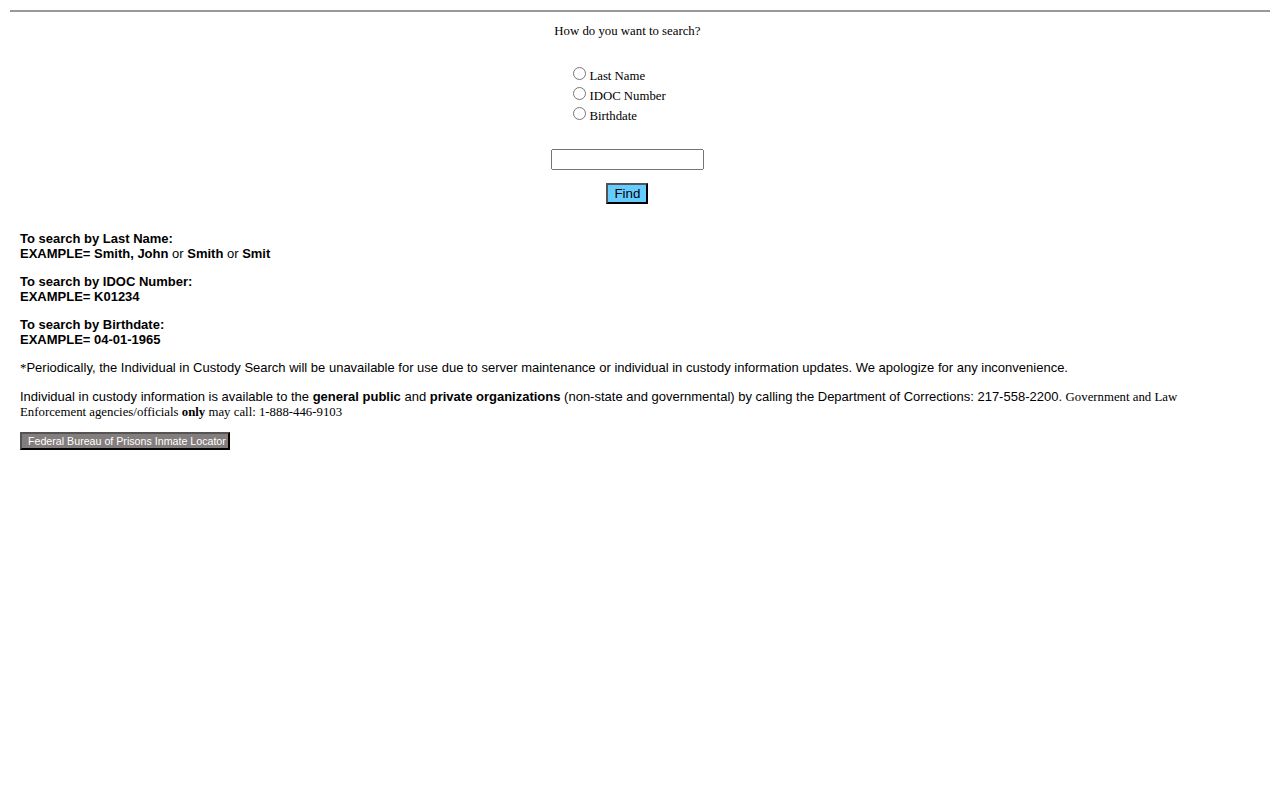
The form is the entry point. A result must still be matched by IDOC number, birth date, status, location, and sentencing county before its projected dates are read.
Read Jefferson IDOC Sentence Rows
Each IDOC row can show mittimus, offense, count, custody date, sentence, county, and whether that sentence is discharged. Read every row. A YES on one count is row-specific. Another count may remain active or run later. Sentencing county connects a record to Jefferson, but a prison's location here does not prove a local sentence.
Concurrent sentences overlap. Consecutive sentences run one after another. Presentence credit and an amended mittimus can alter the calculation. These facts explain different projections, but do not support a homemade computation.
If a profile seems inconsistent, request written confirmation. State the IDOC number and exact fields at issue.
Jefferson County Versus IDOC Dates
A Justice Center sentence and state prison sentence do not share one date system. The Sheriff and sentencing court own the county path. IDOC owns the prison calculation. PRB addresses conditions, defined decisions, revocation, and final discharge.
For county custody, request discharge date, time, authority, and destination. For IDOC, read the profile and seek state confirmation. For federal custody, BOP applies to sentenced people; USMS pretrial movement belongs to federal court and Marshals records. No-result in one system never proves release from another.
Jefferson's inspection documented USMS and outside-county detainees at the Justice Center. That makes the receiving-agency field crucial.
After a Jefferson Release Date
After the projected day, look for a completed status. A person released from prison to MSR remains under IDOC Parole supervision and PRB conditions. Final discharge comes later unless records show otherwise. Revocation may create a new custody episode and recalculated date.
For county jail, compare the court's authority with the Sheriff's processing record. The timestamps can differ because they measure separate acts. If the person went to IDOC, USMS, another county, or another custodian, label it a transfer.
Record when each dynamic result was accessed. Do not publish a named person's projected date as fixed. Seek a fresh response when timing affects a legal process or release plan.
Interpret Jefferson Release Milestones
Do not confuse Projected Parole Date with a promise of a discretionary grant. Most modern determinate Illinois sentences move to MSR by calculation, while traditional parole chiefly concerns older indeterminate cases and defined exceptions. A PRB interview, vote, or decision is not the physical release time. A plan, detainer, or processing step may intervene.
Last Paroled Date can describe an earlier release followed by return. Projected Discharge Date may mark the expected later end of supervision rather than prison exit. Reading all three as one date hides the distinction the official profile preserves.
For a completed state event, compare dates with status, location, and every sentence row. For county custody, obtain the Sheriff discharge field. For final supervision discharge, use the PRB or completed IDOC record. Each source answers one stage.
Jefferson Sentence Date Limits
Sentence credit must be read against the offense and offense date. The 85, 75, and 100 percent floors apply only where the statute assigns them. Other sentences follow other provisions. IDOC may award or revoke eligible credit within the law, and confidential master-file facts can prevent a public forecast of a future award.
A detainer can change the outcome without changing the fact that one custody term reached its calculated point. The person may leave IDOC for another custodian. Confirm the receiver before describing freedom. Jefferson County's outside-agency holds make this check useful.
No source established a universal Jefferson release hour or weekend adjustment. The safe answer is the official field plus a fresh status check, not a shortcut. For county sentences, ask the Sheriff and court. For state sentences, ask IDOC.
Public Record Search
Sponsored Results